

Lakshika Kaushik
How to Save Your Marriage: The Complete Guide for Indian Couples
You love them. But right now, that love doesn't feel like enough.
The distance, the silence, the same fights on repeat, it's exhausting. And somewhere between trying to fix it and not knowing how, you ended up here.
Whether your marriage has felt unhappy for years or something specific broke recently, you are not alone. Over 2.4 million couples hit this exact breaking point every year. The difference between the ones who make it and the ones who don't isn't love; it's getting the right marriage help before it's too late. Research shows 70% of couples who seek therapy not only save their marriage but also build something stronger. The average couple, however, waits years after problems begin before asking for help.
This guide is written by Loveleen Malhotra, a certified marriage and family therapist and relationship therapist at Lyfsmile, who has worked with hundreds of Indian couples, from first-time fights to last-chance sessions. It covers everything: why marriages fall apart, what relationship counseling and marriage therapy actually do, and how couples come back from the edge. No generic advice. No false hope. Just honest answers from someone who has sat across from couples exactly where you are right now.
Is It Really Over? How to Know If Your Marriage Can Still Be Saved
Most couples who ask this question are not actually asking if it's over; they're asking if there's still hope. And the honest answer, in most cases, is yes.
Here's what therapists know that most people don't: the biggest threat to a marriage isn't fighting. It isn't even infidelity. According to Dr John Gottman's 40 years of research across 3,000+ couples, the real sign a marriage is ending is indifference. When partners stop feeling anything, no anger, no hurt, no longing- that's when things get truly difficult. But if you're in pain right now? That pain means the connection still exists.
Your marriage still has a real chance if :
The fights hurt because you still care what your partner thinks of you
At least one of you is willing to try, even if the other isn't sure yet
The problems are about behaviour, communication, trust, and distance, not who you fundamentally are as people
You still have memories of who you were together, even if they feel far away right now
Where things need immediate professional attention:
Is there any form of abuse, physical, emotional, or financial
Active addiction with no acknowledgement or willingness to address it
One partner feels consistently unsafe, emotionally or physically
If your marriage is in crisis, or if it has been quietly unhappy for longer than you can remember, the path forward starts with honest support. Most couples wait years before seeking marriage help. Not because the marriage wasn't savable but because they hoped silence would fix what only honest conversation could.
Coming in early, even when it feels too soon is always the right call.
Early Signs Your Marriage Needs Attention
Every marriage goes through difficult phases, but recognising the warning signs early can make a significant difference. Many couples wait until problems become overwhelming before seeking help, even though early support often leads to better outcomes.
Some common signs your marriage may need professional attention include:
Frequent arguments over small issues
Feeling emotionally disconnected from your partner
Lack of healthy communication
Loss of trust after repeated conflicts or betrayal
Reduced emotional or physical intimacy
Feeling lonely despite living together
Constant criticism, resentment, or avoidance
Thinking about separation or divorce more often than before
If you recognise several of these signs, seeking marriage counselling early can help rebuild understanding before the relationship becomes more difficult to repair
Why Marriages Fall Apart: The Real Reasons Therapists See Every Day
 In thousands of sessions with couples across India and worldwide, the same patterns appear again and again. Here are the 10 most common reasons marriages struggle and what a proven, certified therapy approach can actually do about each one.
Problem #1: You've Stopped Talking (And Started Feeling Like Strangers)
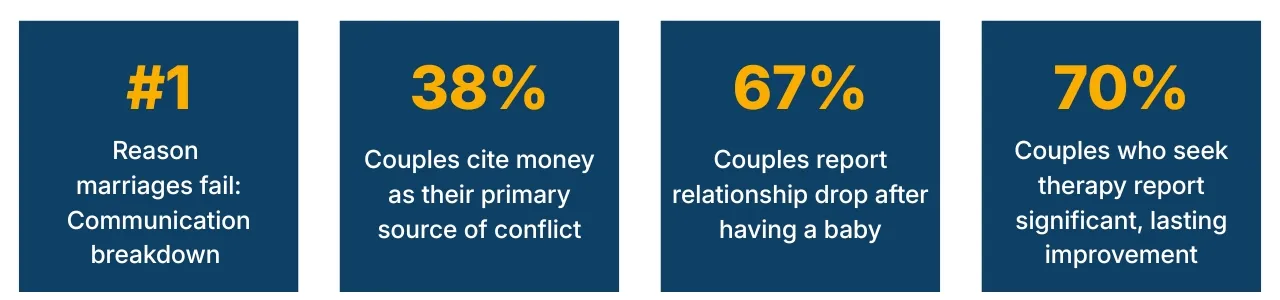
Communication problems in marriage, not infidelity, not money, are the #1 reason marriages fail worldwide. It's the silence. The unspoken resentments, the conversations that never happen, the "I'm fine" when nothing is fine.
The Gottman Institute's research across 3,000+ couples shows that communication quality, not the frequency of conflict, predicts whether a marriage survives. Couples who learn to listen in order to understand, not in order to respond, rebuild connection faster than they expect.
Gottman Method therapy is one of the most proven approaches for communication problems, using tools like the "Sound Relationship House" technique to help couples identify their exact communication breakdown pattern and replace it with habits that build connection instead of quietly eroding it.
Problem #2: The Intimacy Is Gone, and No One Knows How to Bring It Back
Emotional and physical intimacy don't disappear overnight; they fade slowly, quietly. This emotional disconnect in marriage builds until one day you realise you can't remember the last time you truly felt close to your partner.
This is one of the most common and most painful issues therapists encounter. It's also one of the most treatable. Intimacy loss is rarely about a lack of love. It's about unresolved conflict, stress, life pressures, and slow disconnection that was never addressed.
EFT therapy: used for intimacy issues and emotional disconnect in marriage, works directly on the emotional bond between partners, identifying the attachment patterns that created distance and rebuilding the safety that intimacy needs to exist. Research shows EFT has a 73% recovery rate for couples dealing with emotional disconnection.
Problem #3: Trust Is Broken: Can You Ever Get It Back?
Infidelity, whether physical or emotional, is one of the most devastating things a marriage can go through. Trust issues in marriage from an affair physical, emotional, or over WhatsApp and social media affair are equally damaging. Research shows that 20% of men and 13% of women admit to infidelity globally.
Here's what many people don't know: the American Association for Marriage and Family Therapy reports that 53% of couples who experience infidelity and seek professional help say their relationship is stronger afterwards. Recovery is possible, but it requires complete honesty, professional guidance, and genuine commitment from both partners.
Gottman Method's proven Affair Recovery Protocol is the most structured approach to marriage counseling after infidelity, guiding couples through a phased process: Atone, Attune, Attach — acknowledging the full harm of betrayal, rebuilding transparency step by step, and eventually rebuilding a bond that is more honest than what existed before.
Dealing with broken trust in your marriage? Lyfsmile's certified therapists specialise in marriage counseling after infidelity and trust recovery. [Book a confidential session →]
Problem #4: Money Fights That Never Really End
38% of couples worldwide cite financial disagreements as their primary source of conflict. In today's world with inflation, job instability, and rising costs, money fights have become more intense and more frequent.
What's actually happening beneath the money argument is rarely about the money itself. It's about control, security, values, and trust. Two people with different relationships to money will clash unless they build a shared financial vision together.
CBT therapy for couples helps partners identify the deep-rooted beliefs each person carries about money, where they come from, what they represent emotionally and builds a framework for financial conversations that finally don't end in resentment or shutdown.
Problem #5: Family Interference: When In-Laws Become the Real Problem
Family interference is particularly prevalent in Indian, South Asian, and NRI communities worldwide, and it affects couples across every state, from Delhi and Haryana to Maharashtra and Tamil Nadu. When a partner's family of origin becomes the unofficial third person in the marriage, resentment builds silently and fast.
This is not about cutting family off. It's about establishing a healthy hierarchy — where the marriage comes first, and family relationships are valued but not controlled.
Family Systems therapy, one of the most effective approaches for family therapy or marital issues caused by external interference, maps each partner's family dynamics and attachment patterns, helping couples establish clear, kind boundaries with extended family that protect the marriage without destroying the relationships that matter.
Struggling with family pressure on your marriage? Lyfsmile's certified therapists work with Indian couples across India and worldwide — online and in-person. [Book a session →]
Problem #6: You're Fighting the Same Fight on Repeat
If every fight feels like a rerun of the last one, you're stuck in what therapists call a perpetual conflict loop. According to the Gottman Institute, 69% of relationship problems are perpetual, they never fully resolve on their own.
The goal of Conflict couples therapy isn't to eliminate conflict. It's to change how conflict is handled replacing the Four Horsemen of criticism, contempt, defensiveness, and stonewalling with tools that actually bring resolution.
Gottman Method therapy uses proven techniques like the "Aftermath of a Fight" conversation and "Dreams Within Conflict" to help couples understand the emotional need beneath each argument and respond to that need instead of the surface argument. The fight doesn't disappear. But it stops being destructive.
Problem #7: Living Apart: When Distance Becomes Emotional Too
Millions of couples worldwide living in different cities, different countries, different time zones face the unique strain of physical distance that slowly becomes emotional distance. Loneliness, quiet jealousy, the "two separate lives" feeling these erode even strong marriages over time.
EFT therapy delivered online has been clinically validated to be just as effective as in-person sessions. For long-distance and NRI couples, Lyfsmile creates a trusted therapeutic space wherever both partners are in the world to stay emotionally connected, work through trust concerns, and plan forward together with clarity.
Problem #8: Mental Health Is Quietly Destroying Your Marriage
Untreated anxiety, depression, ADHD, or trauma doesn't only affect the individual experiencing it it affects the entire marriage. The partner of someone with untreated mental health issues often becomes a caregiver first, and a husband or wife second. This leads to burnout, resentment, and disconnection even when both people genuinely love each other.
CBT therapy when used in an integrated approach addresses both the individual's mental health needs and the relationship's health at the same time. So both partners receive the support they need, and neither carries the full weight alone.
Problem #9: You Became Parents and Lost Each Other Along the Way
New parenthood is one of the most common triggers for marital breakdown. A Gottman study found that 67% of couples report a significant drop in relationship satisfaction within the first three years after having a baby. The shift from partners to co-parents can feel irreversible but it isn't.
Gottman Method therapy specifically the proven "And Baby Makes Three" approach is designed for exactly this. It helps couples maintain their emotional friendship, manage new responsibilities without losing each other, and consciously protect the relationship that exists beneath the parenting roles.
Problem #10: Your Partner Has Emotionally Checked Out
This is often the most painful situation of all wanting desperately to save the marriage while your partner seems to have already left, at least emotionally. The one-word answers. The physical presence without emotional engagement. The feeling of fighting completely alone.
Here is what's important to know: many checked-out partners are not beyond reach. They have often shut down to protect themselves from further hurt not because they stopped caring. The withdrawal is a defence, not a verdict.
EFT therapy works specifically with couples where one partner has emotionally withdrawn creating a safe enough space for the disengaged partner to slowly re-enter the relationship without feeling attacked or overwhelmed. Over time, it rebuilds the emotional safety that caused them to shut down in the first place. Even when only one partner walks in ready, the shift that happens in the room almost always reaches the other.
Did You Know?
Relationship experts suggest that many couples wait 2 to 6 years after problems begin before seeking professional help. Unfortunately, this delay often allows misunderstandings, resentment, and emotional distance to grow deeper. Seeking support earlier can improve communication, strengthen emotional connection, and increase the chances of rebuilding a healthier relationship.
Book Your Free 15-Minute Session Today : Confidential · Judgment-Free · Available Worldwide Online
How to Save a Failing Marriage: What Therapists Recommend First
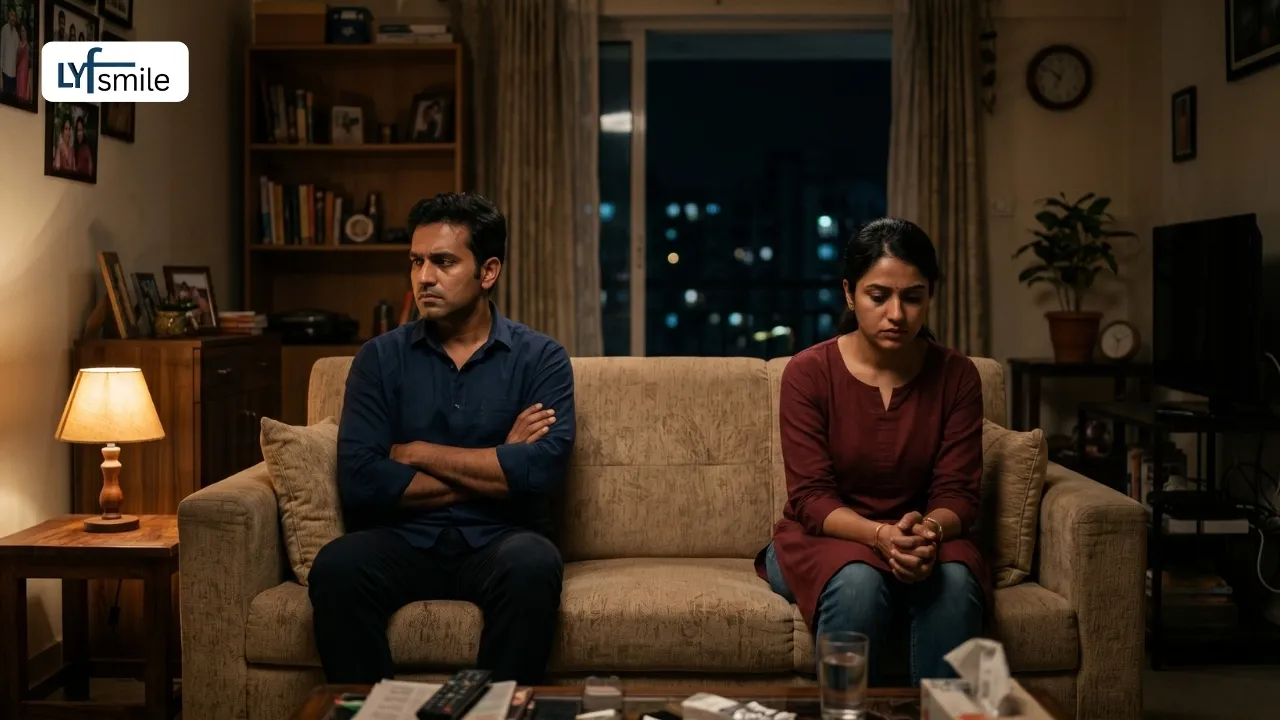 Here is something most couples don't expect to hear in a first session: the problem is rarely what you think it is.
They come in thinking the issue is the fighting. Or the silence. Or the affair. Or the in-laws. And those things are real they matter. But in Lovleen's years of sitting across from struggling couples at Lyfsmile, what becomes clear very quickly is that the surface problem and the actual problem are rarely the same thing.
The fighting is a symptom. Underneath it, almost always, is one thing: two people who have stopped feeling safe with each other. Safe enough to be honest. Safe enough to be vulnerable. Safe enough to reach toward each other instead of defending against each other.
"I've had couples walk into my room ready to file for divorce and within three sessions, something shifts. Not because I gave them a technique. But because for the first time in years, each of them finally felt heard by the other. That's where it always starts."
Everything else — the communication tools, the exercises, the frameworks only works once that safety starts to come back. Which means the first real move in saving a marriage isn't a grand gesture or even therapy itself. It's a quiet, private decision: I am going to stop trying to win and start trying to understand.
That shift from winning to understanding is where every recovery Lovleen has witnessed actually began.
What gets in the way almost every time is contempt. Not anger anger is actually healthy, it means you still care. Contempt is different. It's the eye-roll. The sarcasm with an edge to it. The tone that quietly says "I've stopped respecting you" without a single word being spoken. Dr. John Gottman's research identifies contempt as the single greatest predictor of divorce more than conflict frequency, more than infidelity, more than anything else.
"When I see contempt in the room and you learn to recognize it immediately I know that's where we start. Not with communication exercises. Not with homework. With rebuilding basic respect. Because nothing else works until that's back."
The second thing Lovleen sees immediately: couples are having the wrong conversation on repeat. Not the wrong topic the wrong level. You are arguing about dishes when the real conversation is "do I matter to you?" You are fighting about money when the real question is "do you trust me?" You are talking about in-laws when what's actually being said is "whose side are you on?"
"The moment a couple learns to hear the question beneath the question I watch something physically change in the room. The defensiveness drops. The eyes soften. Because suddenly they're not fighting each other anymore. They're finally talking to each other."
The third thing and this one is uncomfortable to hear: most couples wait until they are in crisis before asking for help. By that point, there are not just the original problems to work through. There are years of walls, years of distance, years of a story each partner has quietly built about who the other person is. "He doesn't care." "She never listens." "We're too different." That story becomes the biggest obstacle not because it's entirely wrong, but because it's incomplete. And it hardens with every year that passes without support.
EFT therapy and the Gottman Method both proven, evidence-based approaches used at Lyfsmilework significantly better before that story has fully set in. The earlier couples come in, the more there is to work with and the faster the work moves.
"I always tell couples the same thing at the end of a first session: the fact that you're both sitting here that you both showed up tells me more about your marriage than anything you've said. Showing up is not a small thing. It's actually everything."
None of this means it's too late if you've waited. It isn't. But it does mean: don't wait any longer than you already have.
Practical Steps You Can Take to Strengthen Your Marriage Today
While every relationship is unique, small and consistent efforts can help couples reconnect and improve their relationship over time.
1. Listen to Understand, Not to Respond
Give your partner space to express their feelings without interrupting or becoming defensive. Active listening helps reduce misunderstandings and builds emotional safety.
2. Communicate Honestly
Share your thoughts calmly instead of letting frustration build up. Honest communication helps resolve issues before they become bigger problems.
3. Spend Quality Time Together
Even 20–30 minutes of uninterrupted conversation or a shared activity each day can strengthen emotional intimacy.
4. Appreciate Small Efforts
Express gratitude for everyday actions. Feeling appreciated helps partners feel valued and respected.
5. Focus on Solving Problems Together
Instead of blaming each other, approach challenges as a team working towards the same goal.
6. Rebuild Trust Through Consistency
Trust grows through honest communication, keeping promises, and showing reliability over time.
7. Seek Professional Support Early
If recurring conflicts continue despite your efforts, working with a qualified marriage therapist can provide practical tools to improve communication, rebuild trust, and strengthen your relationship.
Real Sessions, Real Couples: Stories From a Therapist's Room
Names and identifying details have been changed to protect privacy. These stories are shared with permission.
In all the years Lovleen has worked with couples at Lyfsmile, one thing has stayed consistently true: the couples who make it are not the ones with smaller problems. They're the ones who didn't stop trying.
These are four of those couples.
"We Hadn't Spoken in 3 Months" How One Couple Found Their Voice Again
Rohan and Priya came in sitting as far apart as the couch allowed.
They had been married eleven years. Two kids. A home they had built together. And for three months not an argument, not a fight, just complete silence. Priya said she had stopped trying because every time she spoke, she felt like she was talking to a wall. Rohan said he had stopped responding because everything he said seemed to make things worse.
"In that first session, I didn't ask them to talk to each other," Lovleen recalls. "I asked each of them to just tell me not their partner, me what they missed most about their marriage. Rohan talked for four minutes straight. When he finished, Priya was crying. She said: 'I didn't know you still felt any of that.'"
That was the beginning.
Over the following sessions using Gottman Method therapy, they worked on something specific: the moment each of them shut down, and what was actually happening inside that moment. Rohan's silence wasn't indifference it was fear of saying the wrong thing again. Priya's talking wasn't nagging it was desperation to feel connected.
When they finally understood what the other person's withdrawal actually meant, the silence lost its power.
Eight months later, they renewed their vows. Not with a ceremony, just the two of them, in their kitchen, before the kids woke up.
"I Found Out About the Affair at Midnight" : A Story of Betrayal and Healing
Sunita found the messages on a Tuesday night. By Thursday morning, she was sitting in Lovleen's office at Lyfsmile.
Her husband Vikram, came to the second session. He came, Lovleen says, because somewhere beneath the shame, he still loved his wife and knew he had destroyed something real.
"Affair recovery is the hardest work I do," Lovleen says. "Not because the betrayal can't be healed it can. But because healing it requires the person who caused the pain to stay present through all of it. To not defend, not minimise, not rush the process. Most people don't know how to do that. Learning it takes everything they have."
Using the Gottman Method's proven Affair Recovery Protocol, the structured Atone, Attune, Attach process Lovleen worked with them for nearly a year. There were sessions where Sunita needed to say the same things again, and Vikram needed to hear them again, without deflecting. There were sessions where Vikram talked about what had been missing in himself not as an excuse, but as an honest reckoning.
"The moment I knew they were going to make it was when Sunita said: 'I don't trust you yet. But I trust that you're trying. And right now, that's enough to keep going.'"
They are still together. Sunita says their marriage now is more honest than it ever was before.
Dealing with broken trust in your marriage? Recovery is possible with the right support at Lyfsmile. [Book a confidential session with Lovleen →]
"We Stayed Together for the Kids" : What Therapy Helped Them See
Anjali and Suresh had not considered divorce not officially. But they had stopped being a couple in every way that mattered. They slept in the same bed, raised their children together, and attended family functions side by side. And felt completely alone.
"They came in thinking therapy would help them co-parent better," Lovleen says. "They didn't realize they had stopped being partners before they'd even fully realized it had happened."
The youngest child was nine. The drift had started, they slowly understood, around the time their first child was born twelve years earlier. Twelve years of putting the marriage last. Twelve years of assuming that taking care of everything else was the same as taking care of each other.
EFT therapy brought something to the surface neither of them had named: they were both lonely. Deeply, quietly, inside their own marriage. And both had assumed the other one was fine.
"When Suresh finally said out loud that he missed her not as a mother, not as a co-parent, but as the person he fell in love with Anjali looked at him like she was seeing him for the first time in years."
They did not have an easy road. But they had an honest one. And slowly date nights, small rituals, learning to talk about something other than the children they rebuilt what had quietly slipped away.
"They remind me why early intervention matters," Lovleen says. "They lost twelve years they didn't have to lose. But they didn't lose each other."
"Only I Wanted to Save It" : How One Partner's Effort Changed Everything
Meera came alone to her first six sessions at Lyfsmile.
Her husband Arjun had refused to come. He said therapy was pointless, that things had gone too far, that he didn't see the purpose. Meera came anyway not to fix her marriage alone, but because she needed to understand what had happened and what, if anything, she could still do.
"Working with one partner is different," Lovleen explains. "But it's not without power. When one person in a relationship changes genuinely changes how they respond, how they communicate, what they ask for and how they ask for it the whole dynamic shifts. The other person can't help but respond differently."
Over those six sessions, Meera worked on one thing: how she approached Arjun when she needed to talk. She had always come at him with her hurt fully visible which made him feel attacked, which made him shut down, which made her feel more hurt. She didn't stop feeling hurt. But she learned a different door.
By session seven, Arjun was sitting next to her.
He said he hadn't expected anything to actually change. And then things changed. So he came.
"That couple taught me something I now tell every single partner who walks in alone: you are not powerless just because you're the only one in the room. Sometimes being the only one in the room and doing the work anyway is exactly what brings the other person through the door."
If you're the one still trying that's not weakness. That's exactly where change begins. [Book your first session at Lyfsmile →]
What Actually Happens in Marriage Counseling? (Honest Answer)
Most people imagine marriage counseling as two people sitting across from a therapist, taking turns listing grievances while the therapist nods politely. The reality is quite different and considerably more useful.
"That's one of the first things I tell every new couple at Lyfsmile," Lovleen shares. "This room is not a courtroom. I'm not here to decide who's right. I'm here to help both of you understand what's actually happening between you and give you something real to do about it."
Here is what actually happens.
Session 1 Assessment
The first session is not about fixing anything. It is about understanding.
Lovleen spends this session listening to both partners, to the story of the marriage, to the specific moments where things shifted. Sometimes she meets the couple together. Sometimes, depending on what's brought them in, she meets each partner individually first. Either way, she is not just hearing the content of what's said. She is watching how each person talks about the other. Where the defensiveness lives. Where the pain is. Where, underneath everything, the love still is.
"I can usually sense within the first twenty minutes what the core wound is not the presenting problem, but the real one. It rarely gets named in session one. But knowing it early changes everything about how I work with a couple."
Sessions 2–4 Pattern Identification
What follows is not generic. There is no one-size-fits-all script in couples therapy or there shouldn't be.
These sessions are where both partners begin to see the cycles driving their conflict not just the surface arguments, but the emotional triggers underneath them. Lovleen helps couples understand what is actually happening in the moments things escalate: what each person is feeling, what each person needs, and why the same fight keeps playing out the same way.
"Most couples are surprised by how quickly things shift once they understand their own cycle. Not fix it just understand it. Awareness alone changes behavior. That's not a small thing."
Depending on what Lovleen finds in these early sessions, the approach shifts. Gottman Method therapy brings specific, research-backed tools into the room exercises that help couples identify conflict patterns and build what Gottman calls a "Sound Relationship House": the friendship, admiration, and shared meaning that keep a marriage alive through hard seasons. EFT therapy goes deeper into the emotional attachment between partners why each person responds the way they do, what past experiences are showing up in the marriage without being named, and how to rebuild the safety that genuine intimacy needs.
Sessions 5 and Beyond Skill Building and Real Shift
This is where the work becomes practical. Lovleen gives couples specific tools for communication, for conflict resolution, for rebuilding emotional connection. Small, concrete shifts that get practiced between sessions, not just inside them.
"I tell couples: an hour a week in this room will do very little if the other 167 hours look exactly the same. The session gives you insight. The relationship is where you practice it."
Most couples begin to feel a tangible difference within 6 to 8 sessions not a perfect marriage, but a different quality of interaction. Complex issues infidelity recovery, deep-rooted trauma, years of accumulated distance typically require 20 to 40 sessions over a longer period.
Progress is rarely linear.
There are sessions that feel like breakthroughs where something finally gets said that needed to be said for years. And there are sessions that feel like setbacks, where old patterns resurface and both partners leave quieter than they came in.
"Those harder sessions are often the most important ones," Lovleen says. "The setbacks show us exactly where the deeper work still needs to happen. I never see a difficult session as a failure. I see it as a map."
"What I want for every couple who sits across from me is not a marriage that never struggles. That doesn't exist. What I want is a marriage where both people know how to find each other again after the hard moments. That's what therapy builds not a perfect relationship, but a resilient one."
Wondering what your first session with Lovleen would actually look like? Free, confidential, no pressure. [Book a free 15-minute call to find out →]
Does Marriage Counseling Actually Work? What the Research Says
 The short answer: yes significantly more effectively than most people expect.
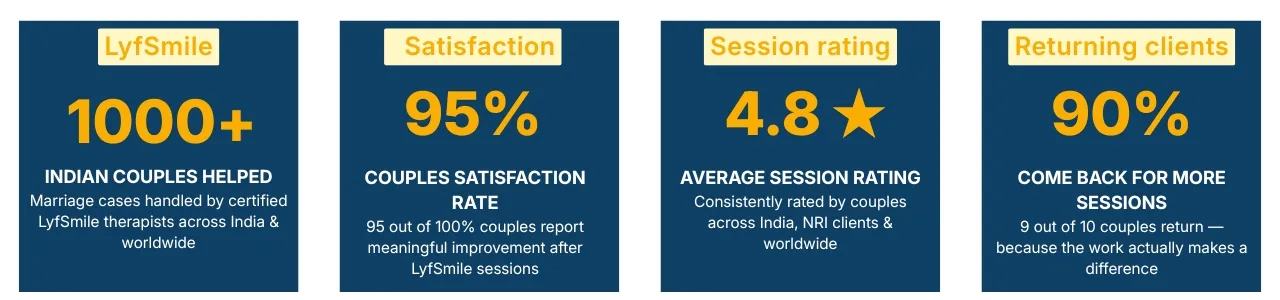
Most people walk into therapy carrying quiet doubt they've tried everything on their own and it hasn't worked. The difference isn't effort. It's having the right tools for what you're actually dealing with. At Lyfsmile, with 120K+ clients across 70+ countries and a 95% couples satisfaction rate, that difference shows up in real results not just research papers.
The numbers speak clearly. 9 out of 10 couples who start at Lyfsmile come back for more sessions. Not because we ask them to because they see the difference themselves. A 4.8-star average session rating across hundreds of couples is not an accident. It is the result of certified, evidence-based therapy delivered by therapists who specialize in exactly what Indian couples face.
The research behind the approach is equally strong. EFT therapy one of Lyfsmile's core methods shows a 73% recovery rate for couples in serious distress, with results that hold up years later. The Gottman Method shows 85% improvement in communication patterns across decades of clinical research. These are not feel-good statistics. They are the foundation of what Lyfsmile's certified therapists bring into every session.
Where therapy works best and where it works less well
Marriage counseling is not a guaranteed fix.
It works best when both partners are genuinely willing even if one is more reluctant than the other. It works best when there is no ongoing abuse, no active addiction being denied, and no complete emotional shutdown on both sides simultaneously. And it works significantly better when couples come in before the damage has become years deep.
What makes the difference is almost never the severity of the problem, it's the willingness. A couple dealing with infidelity who both want to heal will almost always make more progress than a couple with surface-level conflict where one partner has already emotionally left.
What about couples who try therapy and it doesn't work?
Sometimes therapy helps couples arrive at a different conclusion not that the marriage can be saved, but that both people can move forward with clarity and dignity instead of years more of pain. That is not a failure. Sometimes that clarity is exactly what was needed.
The honest bottom line: marriage counseling works meaningfully, measurably, and for a wide range of problems when both partners are willing to show up and do the work. 120K+ clients across 70+ countries have trusted Lyfsmile with exactly that work. And the couples who come out the other side will almost universally say the same thing: they wish they had come sooner.
When Only One of You Wants to Save the Marriage
This is one of the most painful places to be wanting to save something while your partner seems to have already left, at least emotionally.
It feels hopeless. It isn't.
A partner who has checked out is not always a partner who has given up. In most cases, emotional withdrawal is protection not indifference. After months or years of conflict and feeling unheard, shutting down becomes the only way to survive the pain. The walls went up slowly. They can come down the same way.
What actually helps is not pushing harder. More ultimatums, more urgent conversations, more pressure on a partner who is already shut down this almost always produces more shutdown. What moves a disengaged partner is genuine change in the dynamic. When one person shifts how they show up, the entire pattern between them shifts. EFT therapy at Lyfsmile works specifically with this helping the present partner create enough safety for the other to slowly re-engage.
If they refuse to come at all come alone. Understanding your own patterns, your own triggers, your own role in the cycle is work that changes you. And when you change, your marriage changes whether your partner is in the room or not.
If your partner has genuinely and completely decided they are done, therapy still helps not to save the marriage, but to help you move forward with clarity and self-respect instead of more pain. Whether you're hoping to save things or beginning to consider separation, marriage counseling for separation at Lyfsmile gives you the structure and support to handle one of the hardest transitions of your life with dignity, not damage.
How Long Does It Take? Setting Realistic Expectations
There is no single honest answer to this because it depends entirely on what you're working through, how long it's been building, and how consistently both partners engage with the process. What Lyfsmile's therapy can offer is a realistic map, not a fixed timeline.
6–8 Sessions General issues: Communication breakdown, emotional distance, recurring conflict, intimacy loss. Most couples notice a meaningful shift in how they interact less defensiveness, more genuine connection.
20–40 Sessions Deeper issues: Infidelity recovery, years of accumulated resentment, significant trust damage, emotional abandonment. Rushing this work doesn't speed it up it just means the healing is incomplete.
What affects the timeline most:
How long have the problems been present before seeking help earlier always means faster
Whether both partners are genuinely engaged between sessions, not just inside them
The specific issues being worked through some require more time by nature
Session frequency weekly sessions produce significantly faster progress than fortnightly ones
"Couples ask me how long it will take. What I ask them is: how long have you already been hurting? Because most couples have been carrying this for far longer than the therapy will take. A few months of real work versus another year of the same pain is not actually a difficult trade-off."
Online Marriage Counseling : Is It as Effective as In-Person?
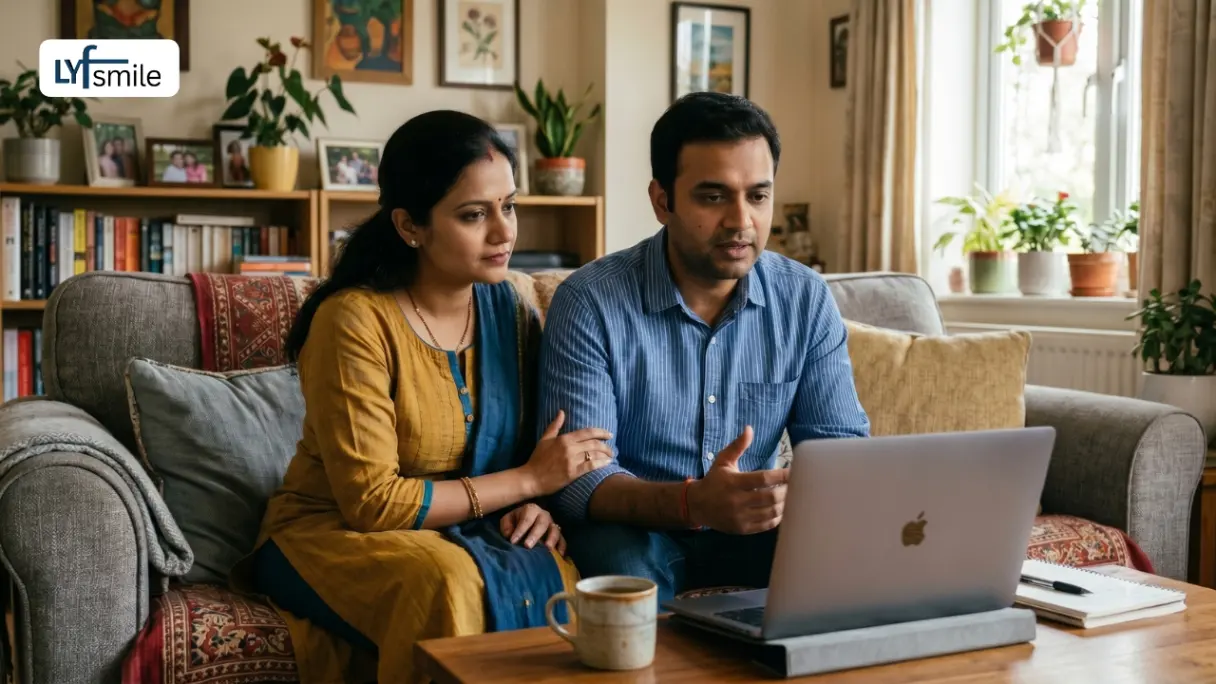 The honest answer, backed by research: yes, when done right, online marriage counseling is as effective as sitting in the same room.
A 2020 meta-analysis published in the Journal of Psychological Disorders found that online therapy produces outcomes comparable to in-person therapy across a wide range of issues including relationship distress. For EFT specifically, clinical results from online sessions match those of face-to-face work. The emotional process is the same. The breakthroughs are the same. The screen doesn't change what actually happens between two people when they finally start being honest with each other.
What Lyfsmile's trusted online counseling makes possible:
Whether you're based in Delhi, Mumbai, Bangalore, Chennai, Hyderabad, Pune, Kolkata, Chandigarh, Jaipur, Lucknow, Ahmedabad, Kochi or anywhere across India Lyfsmile's online sessions mean you get the same proven quality of care without travel, without waiting rooms, and without rearranging your entire day. For NRI couples in the US, UK, UAE, Canada, and Australia online marriage counseling removes the geographical barrier entirely. Sessions are scheduled around your time zone and your life.
Prefer an in-person session?
For couples searching for marriage counseling near me in Delhi, Gurugram, Noida, or Panipat Lyfsmile's offline therapy centers are available across all four locations for face-to-face sessions in a confidential, professional setting. Same certified approach, same trusted care just across the table instead of the screen.
What to look for in an online marriage counselor:
Not all online therapy is equal. The platform matters less than the therapist. Finding the best marriage counselor online means finding someone trained in proven, evidence-based approaches Gottman Method or EFT therapy with specific experience in couples work, not just individual therapy. A certified couples therapist online will structure sessions the same way they would in person: assessment first, pattern identification, then focused skill-building.
"The couples I work with online often tell me they actually feel more comfortable in their own space," Lovleen shares. "There's something about being in a familiar environment that makes it easier for some people to open up. The work isn't any less real sometimes it goes deeper, faster."
One thing online counseling requires more of: commitment.
Without the ritual of physically going somewhere, it's easier to treat a session as optional — to cancel when something comes up, to be half-present because the laptop is also on the dining table. The couples who get the most from online therapy are the ones who treat it exactly as they would an in-person appointment. Same preparation. Same presence. Same willingness to be uncomfortable when the session asks for it.
Working on your marriage from wherever you are affordably. ₹30/min. First 15 minutes free. Online across India & worldwide. In-person at Lyfsmile centers in Delhi, Gurugram, Noida & Panipat. [Book your Lyfsmile session →]
About Loveleen Malhotra
Lovleen Malhotra is a certified relationship therapist at Lyfsmile India's trusted online marriage and couples therapy platform with 120K+ clients across 70+ countries. She specializes in marriage counseling for communication problems, trust issues, infidelity recovery, emotional disconnect, intimacy issues, and relationship problems of all kinds. Lyfsmile offers affordable online marriage counseling for couples across India and internationally and in-person sessions at centers in Delhi, Gurugram, Noida, and Panipat. Sessions in English and Hindi. The first 15 minutes are free. Sessions start at ₹30 per minute.
Final Thoughts
Every marriage experiences challenges, but difficult phases do not always mean the relationship is beyond repair. With honest communication, mutual effort, and the right professional guidance, many couples rebuild trust, strengthen emotional connection, and create healthier relationships.
If you're wondering how to save your marriage, remember that seeking help is not a sign of failure it is a step towards understanding each other better. Whether you're facing communication issues, trust concerns, emotional distance, or repeated conflicts, taking action early can make a meaningful difference in your relationship's future.
Frequently Asked Questions About Saving Your Marriage
How much does marriage counseling cost at Lyfsmile?
Online marriage counseling at Lyfsmile is priced at ₹30 per minute. This makes working with a certified, trusted Lyfsmile therapist affordable without the overhead of clinic visits. A free 15-minute initial consultation is available so you understand the process before committing to anything.
Should I try marriage counseling before filing for divorce?
Yes always. Not only because it might save the marriage, but because couples who come to Lyfsmile before filing make clearer, more considered decisions. Many who came in certain they were done left with a different answer. Others confirmed their decision but moved through it with far more dignity, far less damage, and significantly better outcomes for their children. Filing first and asking questions later almost always makes an already painful process harder than it needs to be. One session can change the entire trajectory of what comes next.
What if my partner refuses to come to marriage counseling?
Come alone. Individual sessions in the context of a struggling marriage are genuinely usefulunderstanding your own patterns and your own role in the cycle creates real change. At Lyfsmile, many partners who initially refused to come eventually walked through the door once they saw something in the dynamic actually shifting. Refusal is not the end of the road. It is often just the beginning of it.
What is marriage separation counseling?
Marriage separation counseling is professional support for couples who are considering or going through a separation whether that means a temporary break to gain clarity, or navigating the transition out of a marriage. At Lyfsmile, separation counseling helps both partners process what's happening, make considered decisions rather than reactive ones, and where children are involved manage the process in a way that minimizes harm. Many couples who come to Lyfsmile for marriage counseling for separation find clarity they didn't expect sometimes toward reconciliation, sometimes toward a more peaceful, dignified end.