


Lakshika Kaushik
Premarital Therapy: How It Helps Couples Prepare for Marriage
Premarital therapy is professional support that helps couples prepare emotionally and practically for marriage. It can help partners improve communication, understand each other's expectations, manage conflict, discuss family boundaries, and identify relationship patterns before marriage.
You do not need to have serious relationship problems to consider premarital therapy. Many couples use it proactively to understand each other better and build healthier ways of handling disagreements, emotions, and important decisions.
If you are wondering whether you are ready for marriage, premarital therapy at lyfsmile can provide a structured and supportive space to explore your concerns before taking the next step.
What Is Premarital Therapy?
Premarital therapy is a form of professional relationship and mental health support designed to help couples explore emotional, communication, and relationship concerns before marriage.
It allows couples to discuss important areas of married life, including:
Communication and emotional expression
Conflict and disagreement
Expectations about marriage
Family roles and boundaries
Financial expectations
Trust and emotional security
Previous relationship experiences
Individual needs and values
The purpose is not to decide whether a couple should get married. Instead, therapy provides a structured environment where both partners can better understand themselves, each other, and the relationship.
Premarital Therapy vs Premarital Counseling: What's the Difference?
Premarital therapy and premarital counseling are often used interchangeably, but they can have slightly different areas of focus.
Premarital Counseling | Premarital Therapy |
Often focuses on practical marriage preparation | May explore deeper emotional and relationship patterns |
Communication and conflict-management skills | Emotional responses and recurring relationship patterns |
Expectations about married life | Attachment and emotional concerns |
Family and financial discussions | Personal history that may affect the relationship |
Preparing for common challenges of marriage | Understanding why certain patterns repeatedly occur |
In simple terms, premarital counseling often focuses on preparing couples for marriage, while premarital therapy may explore the emotional and psychological patterns that influence how partners relate to each other.
The right approach depends on the couple's needs and the concerns they want to work on.
What Are the Signs You May Benefit From Premarital Therapy?
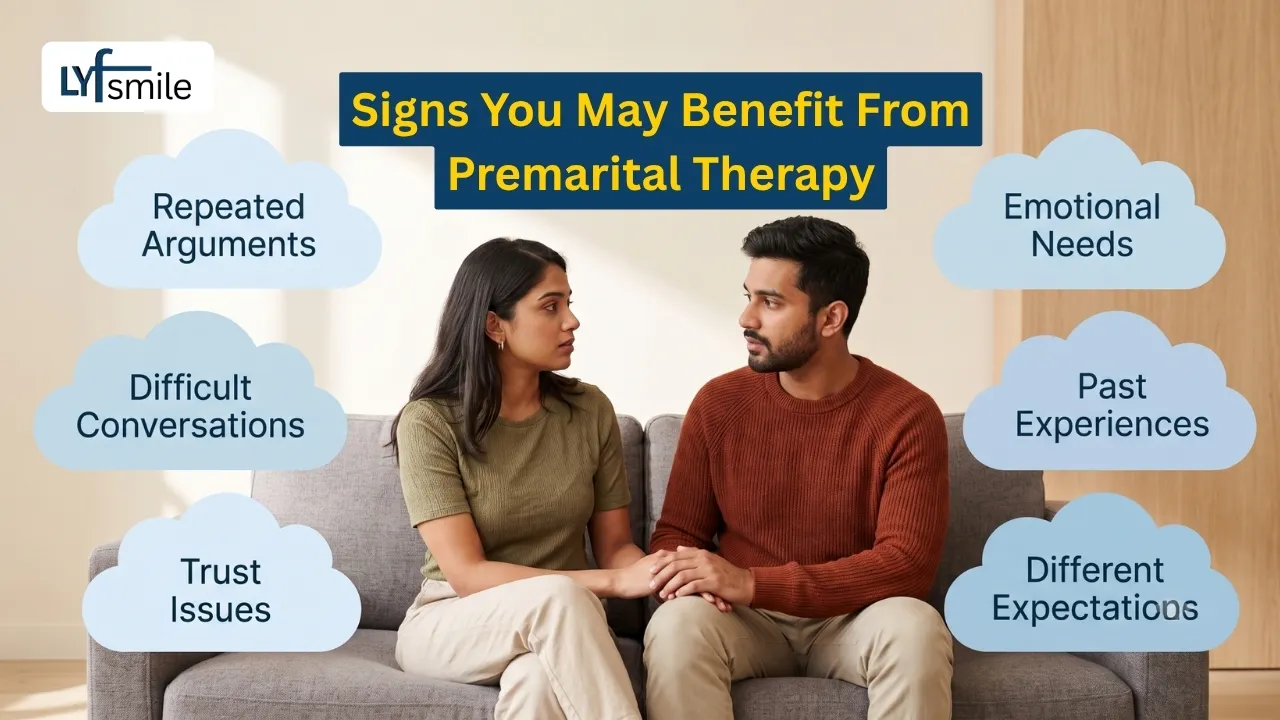 You do not have to be experiencing a major relationship problem to consider premarital therapy. However, certain patterns may indicate that professional guidance could be useful before marriage.
1. You Have the Same Arguments Repeatedly
If conversations about money, family, responsibilities, communication, or other issues repeatedly turn into arguments without a resolution, therapy can help identify the pattern behind those conflicts.
2. You Avoid Difficult Conversations
Some couples avoid discussing uncomfortable topics because they fear conflict. Avoiding important conversations about finances, family expectations, children, careers, or boundaries can create misunderstandings later.
3. You Struggle to Express Your Emotional Needs
If you find it difficult to tell your partner what you need, feel, or expect from the relationship, premarital therapy can provide a safe environment to practise clearer communication.
4. You Have Concerns About Trust or Emotional Security
Frequent reassurance-seeking, jealousy, fear of abandonment, or difficulty trusting a partner may be worth exploring before marriage.
5. Past Experiences Affect Your Current Relationship
Previous relationships, family dynamics, or unresolved emotional experiences can sometimes influence how a person responds to their partner.
6. You Have Different Expectations About Marriage
Couples may have different ideas about finances, household responsibilities, children, careers, family involvement, or personal independence. Discussing these differences before marriage can help prevent avoidable misunderstandings.
You Want to Strengthen Your Relationship Before Marriage
Premarital therapy is not only for couples experiencing difficulties. Some couples choose therapy proactively to improve communication and develop healthier ways of handling future challenges.
These signs do not automatically mean that a couple is not ready for marriage. They simply highlight areas that may benefit from honest discussion and professional guidance.
What Happens During a Premarital Therapy Session?
 A premarital therapy session usually allows both partners to discuss their relationship, concerns, expectations, and communication patterns with a qualified mental-health professional.
Depending on the couple's needs, sessions may include:
Understanding the couple's concerns: The therapist learns what brought the couple to therapy and what they want to work on.
Discussing communication patterns: Partners may explore how they communicate when they are calm, upset, stressed, or in disagreement.
Exploring expectations about marriage: Couples can discuss their expectations around responsibilities, finances, family, careers, children, and personal space.
Identifying recurring conflict patterns: Therapy can help couples understand what tends to trigger disagreements and how they respond to each other.
Discussing family boundaries: Couples may explore how they want to manage relationships and boundaries with parents, relatives, and extended family.
Understanding emotional needs: Each partner can learn how to communicate their needs and understand what makes the other person feel supported.
Setting relationship goals: The therapist may help the couple identify practical areas they want to improve and work on during future sessions.
The exact structure of premarital therapy varies because every couple has different concerns, relationship dynamics, and goals.
Can Premarital Therapy Help Couples in Arranged or Love Marriages?
Yes. Premarital therapy can be relevant to couples in both arranged and love marriages. The concerns discussed in therapy depend more on the couple's individual relationship and circumstances than on how they met.
Premarital Therapy for Arranged Marriages
Couples entering an arranged marriage may want to discuss expectations, emotional compatibility, communication, family involvement, personal boundaries, finances, and future goals.
Premarital Therapy for Love Marriages
Couples who have been together for a long time may use premarital therapy to discuss areas that become more important after marriage, such as finances, family responsibilities, communication, household roles, and long-term plans.
Premarital Therapy for Interfaith or Intercaste Couples
Couples from different religious or cultural backgrounds may want to discuss family expectations, traditions, boundaries, future children, celebrations, and other areas where their expectations may differ.
The purpose of therapy is to create a space where both partners can discuss these topics openly and work toward understanding each other's perspectives.
Premarital Therapy at Lyfsmile
Lyfsmile provides premarital therapy and counseling support for couples who want to prepare for marriage, improve communication, discuss expectations, or work through relationship concerns.
Ms Riya Rathi has a Master's degree in Applied Psychology and a Post Graduate Diploma in Guidance and Counselling. She works with individuals and couples around interpersonal and relationship concerns.
Online and In-Person Support
Premarital therapy sessions are available online for couples across India and internationally, including NRI couples. In-person support is also available at Lyfsmile centres in Delhi, Gurgaon, Panipat, and Noida, subject to therapist availability.
Lyfsmile also offers a free 15-minute consultation, allowing couples to understand the therapy process before deciding whether to continue.
Sessions following the consultation are available at ₹30 per minute.
If you are considering premarital therapy, speaking with a qualified professional can help you understand whether this approach is appropriate for your relationship and goals.
Current pricing/location claims are already present on the page, so yahan maine unhe source content ke according retain kiya hai.
Considering Premarital Therapy?
If you and your partner want professional support before marriage, you can speak with a Lyfsmile therapist to discuss your concerns and understand the next steps.
[Book a 15-Minute Free Consultation]
Frequently Asked Questions About Premarital Therapy
What is premarital therapy?
Premarital therapy is professional support that helps couples explore communication, emotional patterns, conflict, expectations, and relationship concerns before marriage.
Is premarital therapy only for couples with relationship problems?
No. Couples can choose premarital therapy even when their relationship is healthy. Some couples use it proactively to improve communication, discuss expectations, and prepare for challenges that may arise after marriage.
What does premarital therapy help with?
Premarital therapy may help couples discuss communication, conflict, emotional needs, family boundaries, finances, expectations, trust, and other relationship concerns.
What happens during a premarital therapy session?
A therapist may discuss the couple's concerns, communication patterns, expectations, recurring disagreements, emotional needs, and future goals. The exact structure depends on the couple's needs.
When should couples start premarital therapy?
Couples can start before engagement, during engagement, or before the wedding. Starting earlier can give them more time to discuss important topics and work on areas they want to improve.
How many premarital therapy sessions are needed?
There is no fixed number of sessions. The duration depends on the couple's concerns, goals, and the therapist's assessment.
Can premarital therapy help couples in arranged marriages?
Yes. Premarital therapy can help couples in arranged marriages discuss expectations, communication, emotional compatibility, family involvement, boundaries, finances, and future plans.
Can couples take premarital therapy online?
Yes. Online sessions can allow couples to attend therapy from different cities or countries, depending on the therapist and service availability