Lakshika Kaushik
Premarital Counseling for Couples: Strengthen Your Relationship Before Marriage
Premarital counseling for couples helps partners understand their relationship patterns, improve communication, manage disagreements, and prepare for married life together. Sessions can focus on emotional needs, finances, family expectations, intimacy, future plans, and practical ways to handle differences before marriage.
Two people can know each other for years and still be surprised by how differently they respond to stress or disagreements. One may want to discuss a problem immediately, while the other needs time to process emotions. Neither response necessarily means a lack of love, but misunderstanding these differences can create unnecessary tension.
Premarital counseling gives couples an opportunity to understand these patterns and approach their future with greater awareness.
Most Couples Think They're Ready — Here's What They're Missing
Couples can feel ready for marriage while still having unspoken expectations about finances, family involvement, emotional support, personal boundaries, and everyday responsibilities. Recognising these gaps before marriage can help partners understand each other more clearly.
Imagine a couple who rarely argues. One partner believes this means their communication is excellent. The other avoids difficult conversations because they do not want to upset the relationship. Both feel happy, but their approaches may create problems when an important disagreement eventually arises.
Similar blind spots can appear in other areas of married life.
Practical Topics Couples Should Discuss Before Marriage
Before getting married, couples should discuss finances, living arrangements, household responsibilities, careers, children, family boundaries, intimacy, and how they want to handle disagreements. These conversations help partners understand each other's expectations before shared responsibilities begin.
Money and financial independence: Discuss savings, spending habits, existing debts, household expenses, and major purchases. Consider how financial decisions will be made and what financial independence means to each of you.
Living arrangements: Talk about where you want to live, whether you expect to live independently or with family, and how household responsibilities will be divided.
Careers and future plans: Discuss professional ambitions, work schedules, potential relocation, and how you would approach a career opportunity that affects both partners.
Children and parenting: Share your views on whether you want children, possible timelines, and how parenting responsibilities might be divided.
Parents, in-laws, and family boundaries: Discuss family visits, traditions, caregiving responsibilities, and how you would handle disagreements involving relatives. Premarital counseling for family expectations can help couples explore these subjects when their views differ.
Intimacy and personal space: Talk about affection, emotional closeness, privacy, and the boundaries that help each partner feel comfortable and respected.
Conflict and decision-making: Consider what happens when you disagree. Does one person need time to process emotions while the other prefers to resolve things immediately? Understanding this difference can help you decide how to return to difficult conversations.
Lifestyle and social expectations: Discuss friendships, personal interests, religious practices, technology use, and the balance between time together and time apart.
For engaged couples, these discussions can be particularly valuable because wedding preparations often take up so much time that important questions about married life get postponed.
Not every decision needs to be final before the wedding. What matters is that both partners feel able to discuss difficult subjects honestly and understand where their expectations differ.
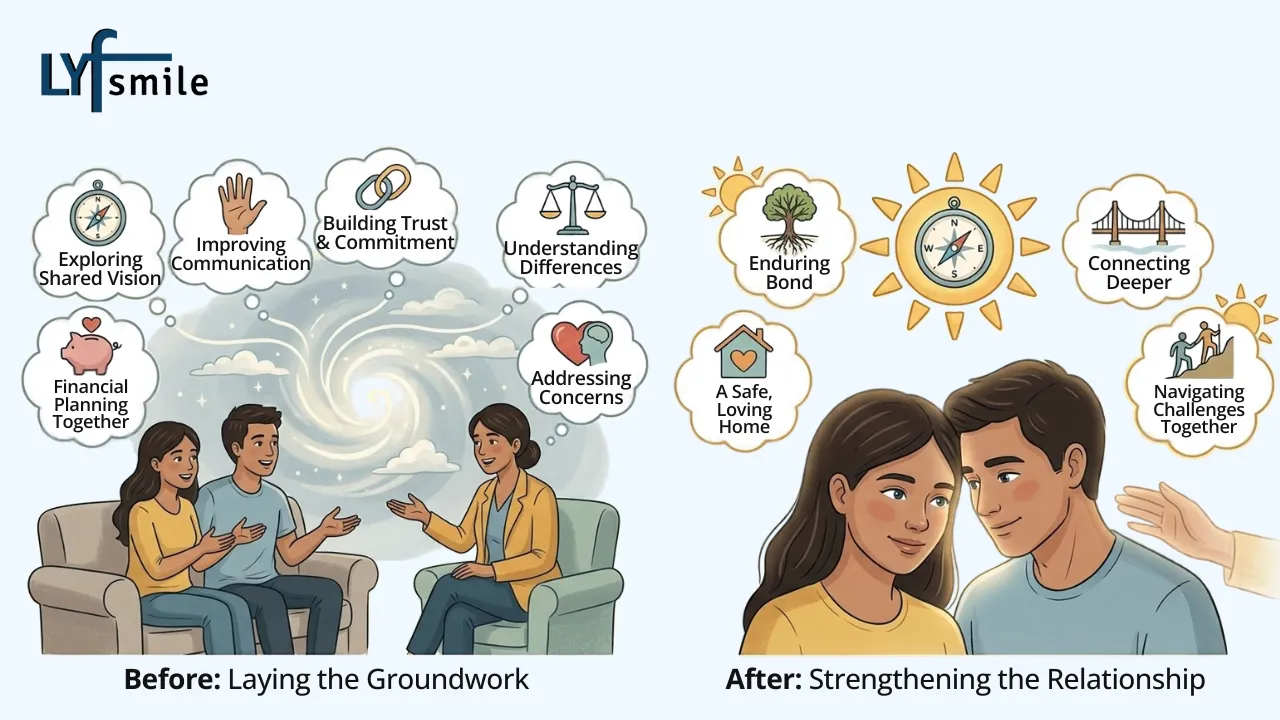
How Counseling Strengthens the Relationship Before Marriage Begins
 Premarital counseling strengthens relationships by helping partners identify recurring interaction patterns, communicate more constructively, understand emotional needs, and develop healthier ways to handle disagreements. Sessions can include guided conversations, reflection on relationship habits, and practical strategies tailored to each couple.
Rather than simply telling partners to communicate better, counseling can help them examine what actually happens when communication breaks down.
Recognising patterns behind disagreements: A counselor can help partners understand why the same argument keeps returning. Perhaps one person feels criticised while the other feels ignored. Identifying this pattern gives both partners a clearer starting point for changing how they respond.
Expressing concerns without creating defensiveness: Premarital counseling for communication issues can help couples practise explaining concerns without blame, listening without immediately defending themselves, and returning to difficult conversations once emotions have settled.
Understanding emotional needs: Partners may seek reassurance, affection, space, or support in different ways. Recognising these differences can help each person understand what makes the other feel heard and valued.
Handling conflict constructively: Couples can learn to acknowledge their part in a disagreement, understand the other person's perspective, and work towards a resolution instead of withdrawing or escalating the argument.
Developing a shared approach to decisions: Counseling gives partners space to discuss how they will handle situations where their preferences do not match. They can explore compromise, personal boundaries, and ways to make decisions that respect both people.
The process can be adapted to different relationship circumstances. Premarital counseling for love marriage may focus on changing expectations as dating becomes a shared life, while premarital counseling for arranged marriage can give partners structured opportunities to understand one another's priorities and values.
For intercaste and interfaith couples, sessions may include cultural identity, religious practices, family traditions, and future decisions. Premarital counseling for NRIs can also help partners explore relocation, long-distance arrangements, cultural adjustment, and the practicalities of building a life across countries.
Counseling does not determine whether two people should marry, nor does it guarantee a conflict-free relationship. Its purpose is to help partners understand how they function together and decide how they want to approach challenges.
Some couples discover that they already have effective ways of handling disagreements. Others identify patterns they would like to change. Both outcomes can be useful because the aim is greater understanding, not judgment.
Start Together, Stay Together: Take the First Step Toward a Healthier Marriage
Lyfsmile offers premarital counseling for couples who want professional support in understanding their relationship, improving communication, and approaching marriage with greater clarity. Sessions are tailored to each couple's circumstances, whether they want to work through a particular concern or discuss their future before the wedding.
A premarital counselor at Lyfsmile can help partners discuss sensitive subjects, recognise relationship patterns, and explore practical ways to address differences in a supportive setting.
Lyfsmile offers online and in-person premarital counseling, giving couples flexibility based on their location, schedule, and comfort. Online sessions can be convenient for partners living in different cities or countries, including NRI couples preparing for marriage across borders. In-person sessions are available at Lyfsmile centers in Delhi, Gurgaon, Panipat, and Noida.
The first 15-minute consultation is free, giving you and your partner an opportunity to discuss your concerns, understand how the process works, and decide whether to continue. After that, sessions are available at ₹30 per minute, making professional guidance more accessible.
You do not need to wait until a disagreement becomes serious to seek support. Sometimes, deciding to understand each other better is simply part of taking your future seriously.
Ready to work on your relationship before marriage? Book your free 15-minute consultation with Lyfsmile. Use the first conversation to discuss what you would like to work on, understand the counseling process, and decide on the next step together.
Frequently Asked Questions
Can premarital counseling help couples who rarely argue?
Yes. Premarital counseling is not limited to couples experiencing conflict. It can help partners understand their interaction patterns, clarify expectations, and discuss subjects they may not have considered in depth.
Do both partners need to attend premarital counseling together?
Attending together is generally useful because the process focuses on understanding each other's perspectives and developing shared relationship skills. Individual sessions may also be considered when appropriate to the couple's circumstances.
Can counseling help couples with different cultural or religious backgrounds?
Yes. Counseling can provide a space to discuss beliefs, family traditions, cultural expectations, and future decisions. It helps partners understand one another and consider how they want to manage differences within their marriage.
What if we discover major differences during counseling?
Discovering differences does not automatically mean a couple cannot have a successful marriage. Counseling can help partners explore concerns, consider practical solutions, and decide what matters most to each of them.
Is premarital counseling useful for couples who have been together for years?
Yes. Time together does not guarantee that every important subject has been discussed. Long-term couples can still benefit from examining their communication patterns, emotional needs, future goals, and ways of handling disagreements before marriage.